
Address
P.O. Box. 29304, San Jose, CA 95123
 Comprehensive
Cancer Consultation Intake Form
Comprehensive
Cancer Consultation Intake Form



The Ohm's Law Formula is familiar to electronics students, but learning the story behind a scientific idea can make it easier to understand and remember. Learning science through discoveries helps students see how questions, experiments, and observations can lead to important ideas. The story of Georg Simon Ohm is a simple example of how scientific knowledge develops.
Science is not only about remembering formulas and definitions. How to learn science through experiments can be understood by looking at how scientists test ideas in real situations. Georg Ohm studied electric current and conductors through repeated experiments, helping him identify a relationship between voltage, current, and resistance.
Georg Simon Ohm was a German physicist and teacher who wanted to understand how electric current behaved in different conductors. Through careful experiments, he compared voltage, current, and resistance and found a consistent mathematical relationship.
The History of Ohm’s Law began with Ohm's experiments and was formally presented in his 1827 book, Die galvanische Kette, mathematisch bearbeitet. His work connected experimental measurements with mathematics and provided a clearer way to describe electrical circuits. Learn more about Georg Simon Ohm and his contribution to electrical science.
Also Read: Explore Health Education and Science Education with Achaani
The Ohm's Law Formula connects three important electrical quantities:
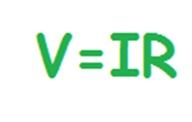
When these values are understood together, students can better predict how a circuit will respond when a battery, resistor, or other component changes.
Ohm's work did not remain inside a laboratory. The principle is now useful in many areas of electronics and electrical engineering. This makes the concept useful for everything from classroom experiments to troubleshooting electronic circuits.
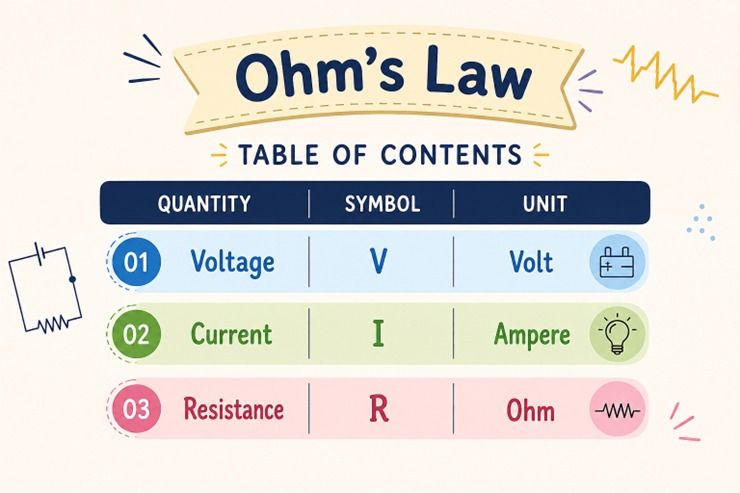
The relationship is commonly written as V = IR and can be rearranged when you need to calculate current or resistance.
For people searching for the creator of Ohm's Law, the answer is Georg Simon Ohm. His experiments showed that electrical behavior could be expressed through a measurable relationship rather than simply described through observation.
Ohm's work was not immediately appreciated when it was published. Recognition came later, and his contribution eventually became so influential that the unit of electrical resistance was named the ohm (Ω) in his honor.
The Ohm’s Law discovery is therefore more than a historical milestone. It demonstrates how persistence, experimentation, and mathematics can transform a scientific question into knowledge that remains useful for generations. Also Read: 5 Mistakes Students Should Avoid
Achaani focuses on creating opportunities for practical learning and exploration. The story of Ohm shows students that important scientific ideas often begin with a simple question and repeated experimentation.
Discover more about science, technology, and hands-on learning at Achaani. The Ohm's Law Formula is more than an equation; it is a reminder that curiosity can lead to discoveries that shape the future.
